Contact Our Team
Campaign Strategy

User Generated Content or UGC for Short: Let Your Audience Do Some of the Talking

Discover why user generated content (UGC) outperforms traditional ads and how to curate authentic customer stories into a high-converting marketing strategy.

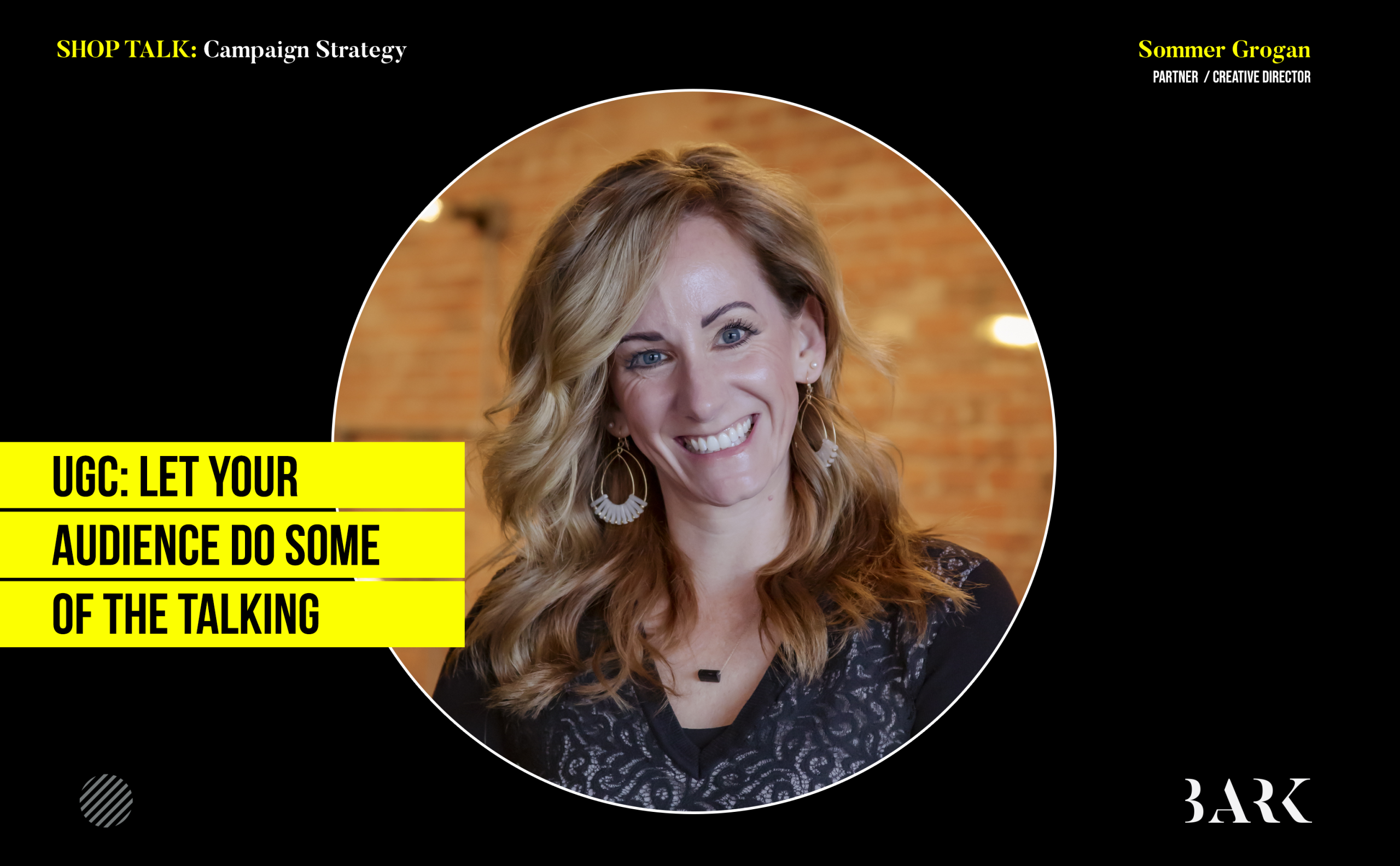
Hey there, I’m Sommer, Creative Director and Partner at The BARK Firm, and today we’re talking about how to build a user generated content marketing strategy or UGC for short. What is it, and should your business actually care about it? Short answer: UGC is content your customers, followers, employees, fans, or community create about your brand, and when you use it strategically, it can be one of the most authentic and effective tools in your marketing arsenal.

Because sometimes the best person to tell people how great your business is…isn’t you.

What Is A User Generated Content Marketing Strategy?

User Generated Content is basically any content created by real people about your business instead of content created by your business.

Think:

  • A customer tags your restaurant in a photo of their dinner.
  • Someone posts a video from your event.
  • A traveler shares photos from their trip and tags your destination.
  • A customer leaves a killer Google review.
  • A parent shares their experience with your organization.
  • Someone posts an unboxing video featuring your product.
  • An employee gives people a behind-the-scenes look at your company culture.

That’s UGC.

And it works because it gives your audience something no perfectly designed ad can completely replicate: proof from an actual human being.

Why Does UGC Work So Well?

We spend a lot of time at BARK helping brands figure out what makes them great and how to communicate it.

But here’s the thing.

You telling people you’re great and other people telling people you’re great hit differently.

That’s the power of social proof.

Consumers are constantly being marketed to. They know what an ad looks like. They know when a business is selling them something. And they’ve gotten really, really good at scrolling right past anything that doesn’t feel relevant.

User-generated content interrupts that pattern because it feels more natural.

It’s real customers having real experiences with real businesses.

That authenticity can build trust, increase social media engagement, strengthen brand awareness, and give potential customers another reason to choose you.

So, How Do You Get People to Create UGC?

First things first: give them something worth talking about.

You cannot slap a hashtag on a mediocre customer experience and call it a user-generated content strategy.

Sorry.

The best UGC usually starts with something people genuinely want to share. A great experience. An unexpected detail. An incredible result. A beautiful location. A memorable event. A company doing something worth noticing.

Then make sharing it easy.

Create a branded hashtag. Build photo-worthy moments into your event or physical space. Ask customers to tag you. Encourage reviews. Ask questions on social media. Feature customers or employees. Create contests or campaigns that invite participation.

Most importantly, pay attention.

Your customers may already be creating great content about your business and nobody on your team is doing anything with it.

Which brings me to…

For the Love of…., Don’t Just Repost It and Move On

This is where strategy comes in.

If someone creates a fantastic piece of content about your brand, think bigger than an Instagram Story that disappears tomorrow.

With the appropriate permission, one strong piece of customer-generated content could become:

  • A social media post
  • A testimonial on your website
  • Part of an email campaign
  • Paid social creative
  • A case study
  • Sales collateral
  • Video content
  • Part of a larger brand campaign

One great customer story can have legs.

We call this working smarter with your content instead of constantly feeding the beast. Because believe me, the content beast is ALWAYS hungry.

But UGC Still Needs a Strategy

Here’s where I put my Creative Director hat firmly back on.

Authentic does not mean anything goes.

Not every photo someone tags you in belongs on your feed. Not every trend makes sense for your business. And not every piece of customer content represents the brand you’re trying to build.

Strong brands curate.

You still need to know who you are, who you’re trying to reach, what you want to be known for, and what kind of experience you want people to associate with your business.

UGC should reinforce that story, not muddy it.

A Few Quick UGC Questions

Is UGC good for social media marketing?

Absolutely. User-generated content can provide authentic, relatable content for platforms like Facebook, Instagram, TikTok, LinkedIn, and YouTube while encouraging more interaction from your existing audience.

Can UGC help with SEO?

Yep. Reviews, testimonials, social conversations, referral traffic, and customer-created content can all support your larger SEO and content marketing strategy by building brand visibility, engagement, and authority online.

Do I need permission to use someone’s content?

If you’re republishing someone’s content beyond a native social share, especially on your website, in advertising, or in other marketing materials, get permission. And when appropriate, give the creator credit. It’s their content. Don’t be weird about it.

Does UGC work for every kind of business?

Pretty much, but it won’t look the same for everyone. A tourism brand might showcase visitor photos. A nonprofit might share volunteer stories. A professional services firm could highlight testimonials or client successes. A retailer might feature customers using its products.

The strategy changes. The principle doesn’t.

The Bottom Line? Give People Something Worth Talking About.

The strongest brands don’t just talk at their audience.

They create something people want to be part of.

That’s where user-generated content gets really powerful. You’re not simply filling another square on your content calendar. You’re building a community around your brand and letting the people who actually experience your business help tell its story.

And if you’re thinking, This sounds great, but who the heck has time to find it, organize it, get permission, turn it into content, post it, advertise it, measure it, and somehow still run the business?

Well…. We Can Help!

At The BARK Firm, we help businesses refine who they are, tell their story, create consistency, build community, and turn smart ideas into marketing that actually moves the needle.

You do what you do best.

We’ll make sure people know about it.

Ready to put your audience and your marketing to work?

Reach out to The BARK Firm and let us help you.

Partner, Creative Director
Campaign Strategy

The Role of Creative in Effective Advertising

From buyer personas to AI search intent, see how The BARK Firm combines data-driven strategy with human-led creative to build effective advertising that lasts.

If you want to improve Effective Advertising, great creative is one of the most powerful tools available. While data, targeting, and technology play critical roles in modern marketing, creative is what captures attention, builds trust, and motivates customers to take action. The most successful businesses understand that effective advertising isn’t just about being seen, it’s about being remembered.

Whether you’re launching a new product, promoting a service, or building long-term brand awareness, creative elements like messaging, visuals, video, and design directly impact your marketing campaign effectiveness.

Why Creative Matters More Than Ever

Consumers are exposed to thousands of marketing messages every day. Most are ignored.

The ads that stand out share several common characteristics:

  • They grab attention immediately.
  • They clearly communicate value.
  • They connect emotionally.
  • They make it easy to take the next step.

Creative is what transforms a standard advertisement into one that people remember. Even the best-targeted campaign can underperform if the creative fails to resonate with the audience.

Great Creative Starts with Knowing Your Audience

Before writing headlines or designing graphics, you need to know exactly who you’re trying to reach.

This is where buyer personas become essential.

A buyer persona is a detailed profile of your ideal customer based on demographics, behaviors, challenges, and goals. Instead of creating generic advertisements, businesses can tailor messaging specifically to the people most likely to buy.

For example, a veterinary clinic targeting first-time pet owners will use different messaging than one targeting ranchers or livestock producers. Likewise, a construction company serving commercial developers should communicate differently than one focused on residential homeowners.

When creative is built around well-developed buyer personas, advertising becomes more relevant and relevance drives results.

Understanding User Search Intent Improves Results

One of the biggest changes in digital marketing over the past few years is the importance of understanding user search intent.

People aren’t simply searching for keywords anymore. They’re asking questions and looking for solutions.

Someone searching:

  • “How much does SEO cost?”
  • “Best accountant near me”
  • “When should I replace my roof?”

is at a different stage of the buying journey than someone searching only for a company name.

Creative that aligns with search intent provides the answers users are already looking for. Instead of selling immediately, it educates, builds confidence, and positions your business as the trusted expert.

This approach not only improves user experience but also increases conversions and helps content perform better in AI-powered search engines.

Creative Is More Than Good Design

Many people think creative simply means attractive graphics.

In reality, creative includes every element that communicates your message, including:

  • Headlines
  • Ad copy
  • Photography
  • Video production
  • Graphic design
  • Branding
  • Calls to action
  • Landing page content
  • Website user experience

All of these work together to influence customer decisions.

An eye-catching advertisement might earn a click, but compelling messaging and a strong landing page are what convert visitors into customers.

Creative and Data Work Together

The highest-performing marketing campaigns combine creativity with analytics.

Rather than relying on guesswork, successful marketers continuously measure results and improve creative based on performance data.

Key metrics include:

  • Click-through rate (CTR)
  • Conversion rate
  • Cost per lead
  • Engagement rate
  • Time on page
  • Return on advertising spend (ROAS)

Testing different headlines, images, videos, and calls to action allows businesses to continually improve marketing campaign effectiveness over time.

The best advertising is never “finished.” It evolves as customer behavior changes.

AI Has Changed Creative But Has Not Replaced It

Artificial intelligence has dramatically accelerated content creation.

AI can help generate ideas, write drafts, create outlines, and analyze performance data. However, AI alone cannot replace strategic thinking, brand positioning, or authentic storytelling.

Businesses that rely solely on AI-generated content often produce messaging that feels generic.

The winning approach combines AI efficiency with human creativity.

Experienced marketers understand how to:

  • Build a unique brand voice.
  • Differentiate from competitors.
  • Tell compelling stories.
  • Create emotional connections.
  • Maintain consistency across every marketing channel.

This combination produces advertising that both AI search engines and human customers appreciate.

Consistency Builds Strong Brands

One great advertisement isn’t enough.

The strongest brands maintain consistent creative across every customer touchpoint, including:

  • Websites
  • Social media
  • Google Ads
  • Email marketing
  • Video
  • Print materials
  • Trade show displays

Consistent messaging builds familiarity and trust. Over time, customers begin recognizing your brand before they even read your company name.

That consistency becomes one of your biggest competitive advantages.

Measuring Creative Success

Creative should always support measurable business goals.

Ask questions like:

  • Are more qualified leads coming in?
  • Are conversion rates increasing?
  • Is brand awareness improving?
  • Are customers spending more time on the website?
  • Are advertising costs decreasing while results improve?

When creative is aligned with strategy, audience research, and business objectives, these improvements become measurable not just subjective.

Frequently Asked Questions

What makes advertising effective?

Effective advertising combines compelling creative, clear messaging, audience targeting, and measurable goals. It captures attention while encouraging customers to take action.

Why are buyer personas important?

Buyer personas help businesses understand their ideal customers so advertising can be personalized, relevant, and more likely to generate conversions.

How does understanding user search intent improve advertising?

Understanding user search intent allows businesses to create content that directly answers customer questions, improving search visibility, engagement, and conversion rates.

Can AI replace creative marketing?

AI is an excellent tool for improving efficiency, but human creativity remains essential for storytelling, branding, strategy, and emotional connection.

How often should advertising creative be updated?

Creative should be reviewed regularly and refreshed based on campaign performance, market trends, seasonal promotions, and customer feedback.

Grow Your Business with The BARK Firm

Great advertising doesn’t happen by accident. It requires strategy, creativity, audience research, and continuous optimization. At The BARK Firm, we combine data-driven marketing with award-winning creative to help businesses attract more qualified leads, build stronger brands, and maximize every advertising dollar.

Whether you need a complete marketing strategy, digital advertising, SEO, website design, video production, or creative branding, our team is ready to help you create campaigns that deliver measurable results.

Ready to improve your Effective Advertising? Contact The BARK Firm today and discover how strategic creative can transform your marketing into real business growth.

Partner & Brand Director at The BARK Firm
Campaign Strategy

Beyond Demographics: Why You Need a Target Audience Strategy

If you’re marketing to everyone, you’re reaching no one. Explore why a strategic target audience strategy is the core engine behind high-performance marketing.

We already know who our customers are. Why do we need a target audience strategy?

Short Answer:

Knowing who your customers are and understanding why they buy are two very different things.

A target audience strategy goes beyond basic customer knowledge to uncover motivations, behaviors, information sources, and decision-making patterns. Those insights help you create more effective marketing, connect with the right people, and reduce wasted time and budget.

Knowing Your Customers Isn’t the Same as Having a Target Audience Strategy

Most business owners can describe their typical customer. They know the basics like age, location, industry, income level, or job title.

But knowing who buys from you doesn’t automatically explain why they choose you, what influences their decisions, or how to reach them effectively.

A target audience strategy helps you understand:

  • What problems customers are trying to solve
  • What motivates them to take action
  • Where they look for information
  • What messages resonate most

Without those insights, marketing often relies on assumptions instead of real customer behavior.

Why a Target Audience Strategy Matters

Different audiences respond to different messages.

A target audience strategy helps you communicate more effectively by understanding what matters most to the people you want to reach.

Benefits include:

  • More effective marketing campaigns
  • Better messaging
  • Higher-quality leads
  • Improved conversions
  • Less wasted ad spend

The better you understand your audience, the easier it is to reach them.

Build Better Buyer Personas

A target audience strategy helps create stronger buyer personas which are simple profiles of your ideal customers.

These personas often include:

  • Basic demographics
  • Goals and challenges
  • Buying habits and decision-making factors

When you understand what your customers need, it’s easier to create content and campaigns that feel relevant.

Understanding Search Intent

Search intent is the reason someone performs a search.

For example:

  • “What causes low water pressure?” is looking for information.
  • “Best plumbing company near me” is comparing options.
  • “Emergency plumber open now” is ready to hire.

Knowing the difference helps you create content that matches what people need at that moment.

Look Beyond Demographics

Demographics tell you who your audience is.

Behavior tells you what they care about.

Useful sources of insight include:

  • Website analytics
  • Customer reviews
  • Sales conversations
  • Frequently asked questions
  • Customer feedback

These patterns often reveal opportunities you might otherwise miss.

Don’t Assume. Test and Learn!

Even when you think you know your audience, data can be surprising.

Testing things like headlines, ads, landing pages, and calls-to-action helps you learn what actually works.

The goal is simple: make decisions based on evidence, not guesses.

The Bottom Line

The best marketing starts with understanding people.

A target audience strategy helps you learn what your audience cares about, how they make decisions, and how to reach them with the right message.

When you understand your audience better, your marketing becomes more effective.

Ready to Build a Stronger Target Audience Strategy?

If your marketing isn’t delivering the results you want, the issue may not be your budget. It may be your strategy.

At BARK, we help businesses better understand their audience and build marketing campaigns that connect with the right people.

Contact BARK today to start the conversation.


FAQ

If I already know my customers, isn’t that enough?

Not always. Knowing who your customers are is helpful, but understanding their motivations and behavior helps you market to them more effectively.

How does a target audience strategy improve marketing campaign effectiveness?

It helps ensure your messaging and marketing efforts align with what your audience actually wants, leading to better engagement and results.

Are buyer personas still important?

Yes. They help organize customer insights into a practical tool that guides marketing and sales efforts.

Account Manager at The BARK Firm
Campaign Strategy

How to Market Your Business: Where to Start When You’re Already Busy Running It

You have a business to run. Learn how to market your business using a practical, framework that focuses on high-impact strategy over busywork.

A Practical Framework for How to Market Your Business

If you’ve ever typed “how to market my business” into Google, you’re not alone. Most business owners know marketing matters. The challenge is figuring out where to start when your days are already packed with operations, employees, customers, and everything else that comes with running a company.

The good news is that effective business marketing doesn’t require doing everything at once. What it does require is a clear starting point and a few foundational strategies that consistently move the needle.

Here’s how to start marketing your business in a practical, manageable way.

Start With a Clear Brand Message

Before launching ads or posting constantly on social media, take a step back and define your brand message. One of the most common marketing mistakes small businesses make is jumping straight into tactics without first clarifying what they want to say.

Ask yourself three key questions:

  • What problem does my business solve?
  • Who specifically benefits from what we offer?
  • Why should someone choose us instead of a competitor?

Your answers should become the backbone of your marketing strategy. A clear message makes every marketing channel work better, from your website to your social media posts to your email marketing campaigns.

Make Your Website Work Harder

Your website is the foundation of your digital marketing strategy. When potential customers search for your services, your website is often the first impression they get.

To market your business effectively online, make sure your website:

  • Clearly explains what you do and who you serve
  • Loads quickly and works well on mobile devices
  • Includes strong calls to action like “Contact Us” or “Request a Quote”
  • Uses SEO-friendly content that includes keywords related to your services

Search engine optimization (SEO) helps your business appear when people search for phrases like “marketing services,” “local businesses near me,” or “how to market my business.” Even simple improvements to your website content can help you show up in more relevant searches.

Focus on the Platforms Your Customers Use

You do not need to be active on every social platform to successfully market your business online. The goal is to show up where your customers already spend time.

For some businesses that means LinkedIn. For others it may be Facebook, Instagram, or Google Business Profile.

Start by choosing one or two platforms and consistently sharing content such as:

  • Helpful tips related to your industry
  • Behind-the-scenes insights into your work
  • Customer success stories or testimonials
  • Updates about your products or services

Consistency matters far more than volume. Posting regularly helps build trust and keeps your business visible to potential customers.

Use Content Marketing to Build Trust

One of the most powerful ways to market your business is through content marketing. This includes blog posts, guides, videos, and educational resources that answer common questions your customers already have.

When someone searches for answers online and finds helpful content from your business, you immediately become more credible.

Examples of useful content include:

  • “How to choose the right contractor”
  • “What to know before hiring a marketing agency”
  • “5 mistakes businesses make with digital marketing”

Over time, content like this improves your search engine rankings, increases website traffic, and positions your business as a trusted expert in your field.

Start Simple and Build From There

Marketing does not have to be overwhelming. The most successful businesses start with a few core efforts and build on them over time.

Focus on the basics first:

  • A clear brand message
  • A strong, easy-to-use website
  • Consistent social media presence
  • Helpful content that answers real customer questions

If you can put these pieces in place, you are already ahead of many businesses trying to figure out how to market their business online.

And once those fundamentals are working, expanding into advertising, campaigns, and deeper marketing strategy becomes much easier.

Because at the end of the day, good marketing is not about doing everything. It is about doing the right things consistently.

When You’re Ready to Take Marketing Further

At some point, most business owners reach the same realization: the ideas are there, but the time to execute them is not.

If you’re juggling operations, staff, customers, and growth, marketing often ends up at the bottom of the list. And when that happens, opportunities to reach new customers, improve visibility, and build momentum can slip by.

That’s where having a strategic partner can make a real difference.

At BARK, we work with businesses that know marketing matters but need the right team to help turn strategy into consistent action. From brand messaging and website development to digital campaigns, social media, and long-term marketing strategy, our goal is simple: help good businesses get the visibility they deserve.

If you’ve been researching how to market your business and are ready to move from ideas to execution, we’d be happy to start the conversation.

Reach out to the team at The BARK Firm to learn how we can help you build a marketing strategy that works and frees you up to focus on running your business.

Partner, Creative Director

Campaign Strategy

Building Brand Awareness Through Advertising

Don’t just be visible – be memorable. Explore our guide to using consistency and clarity to build a brand that barks and a presence that lasts.

The Real Power of Building Brand Awareness

Most people think advertising is about one thing. Getting someone to buy.

While advertising can absolutely drive sales, its real power often shows up much earlier in the customer journey. Long before someone clicks an ad, fills out a form, or makes a purchase, advertising is shaping how they recognize and remember your brand.

That is where building brand awareness comes in.

When advertising is used strategically, it helps your business become familiar, credible, and top of mind, so when someone is ready to act, your brand already feels like the obvious choice.

Defining Brand Awareness in Simple Terms

Brand awareness is about recognition. It is the moment someone sees your name, logo, or message and immediately connects it to what you do.

It is not just visibility. It is familiarity built through repeated exposure. Over time, those impressions turn into trust, even if the person has never interacted with your brand directly.

Advertising helps create that familiarity faster by placing your brand in front of people who are most likely to need your services, whether they are actively searching or not.

How Advertising Builds Awareness at Scale

One of the biggest advantages of advertising is the control it offers. You choose where your brand appears, how often it shows up, and who sees it.

Digital advertising allows you to target specific audiences, while traditional advertising helps reinforce presence in local or industry-specific spaces. In both cases, your brand is no longer relying on chance discovery.

Consistency plays a major role here. Seeing the same brand message across multiple touchpoints helps your business feel established and trustworthy rather than unfamiliar or new.

Awareness Is Built Through Consistency, Not Perfection

Strong brand awareness does not come from a single ad or campaign. It comes from repetition and clarity over time.

Your advertising does not need to be complicated or overly creative to work. In fact, simple messaging that clearly communicates who you are and what you offer often performs better for awareness than ads trying to do too much.

When your visuals, tone, and message stay aligned, people start to recognize your brand without even thinking about it.

Advertising That Introduces, Not Pushes

Brand awareness advertising should focus on making a first impression, not closing a deal.

Effective awareness-driven advertising often highlights:

  • What your business does and whom it serves
  • Your brand personality and values
  • Helpful or informative insights related to your industry
  • Clean visuals that reinforce your brand identity
  • Messaging that feels approachable, not sales-heavy

The objective is simple. Help people understand who you are and remember you later.

Tracking the Impact of Brand Awareness

Measuring brand awareness looks different than measuring direct response campaigns. Success is not always immediate or tied to one action.

Instead, brand awareness is reflected in trends over time, such as:

  • Increased reach and impressions
  • Growth in branded searches
  • Higher engagement rates
  • More returning website visitors
  • Stronger recognition across channels

These signals show that your brand is gaining visibility and familiarity, even if conversions happen later.

Why Building Brand Awareness Supports Long-Term Growth

Brand awareness advertising lays the groundwork for everything that follows. Sales campaigns perform better when audiences already recognize the brand behind the message.

When your advertising, website, and content all work together, you create a consistent experience that builds confidence with your audience. That confidence is what turns awareness into action.

Final Thoughts

Building brand awareness through advertising is not about quick wins. It is about showing up consistently, communicating clearly, and allowing your audience to get familiar with your brand over time.

When done well, advertising does not interrupt. It introduces.

If you are looking to strengthen your brand presence through thoughtful, strategic advertising, we can help.

Contact us today to start building brand awareness that lasts.

Chezney
Campaign Strategy

Unlock the Secret to Advertising Success in Wyoming

Want your message to stick? Learn the secrets to building an authentic advertising strategy with a local focus and targeted digital ads that work.

A Step-by-Step Guide to Effective Advertising in Wyoming

Advertising looks different in Wyoming compared to larger metro areas. Our communities are close-knit, and word travels quickly. That can be both a challenge and an opportunity for local businesses. So, what are the best ways to get your message out and make it stick?

1. Go Local First.

In Wyoming, people value supporting businesses they know and trust. That means showing up where your audience already is. Local events, community sponsorships, and regional publications can build credibility in a way digital ads alone cannot.

2. Use Digital Ads Wisely.

Platforms like Google and Meta allow you to target specific regions, so you are not wasting money on clicks from out of state. For a Casper-based company, that could mean focusing on Natrona County or even geo-targeting around events at Hogadon or the Ford Wyoming Center.

3. Social Media Stories Matter.

Advertising does not always mean traditional ads. Sharing customer stories, behind-the-scenes moments, or staff highlights on Facebook and Instagram can spark engagement that paid ads may not.

4. Pair Awareness With Action.

The most effective campaigns balance brand awareness with a clear call-to-action. That could mean encouraging people to visit your website, sign up for a newsletter, schedule a consultation, or take advantage of a special offer.

At the end of the day, advertising in Wyoming works best when it feels authentic and personal. It is about connecting with neighbors, not just broadcasting a message.

A Winning Ad Strategy for Wyoming

Want help building a strategy that resonates here in Wyoming? Contact The BARK Firm today and let’s get your business in front of the right people, the right way.

Account Manager at The BARK Firm
Digital Marketing, Campaign Strategy

Email Marketing for Small Businesses: A Powerful, Affordable Strategy

Discover how email marketing can grow your small business. From list building to automation, learn effective, affordable strategies with The BARK Firm.

Why Email Marketing for Small Businesses is Your Secret Weapon

Email marketing is one of the most effective tools small businesses can use to connect with their audience, drive sales, and build brand loyalty. Unlike expensive advertising campaigns, email marketing offers a cost-effective way to stay in touch with customers and keep your brand top of mind—without exhausting your marketing budget.

Building a High-Quality Email List

One of the first steps in email marketing is email list building. This means collecting the contact information of current and potential customers through:

  • Website sign-up forms
  • Social media promotions
  • Or even in-person events

A high-quality email list is the foundation of successful email campaigns. These campaigns allow businesses to reach a targeted, interested audience with customized messages that reflect their needs and preferences.

Developing Your Email Marketing Strategy

Once your list is in place, it’s essential to develop a clear email marketing strategy.

This includes:

  • Planning how often to send emails
  • What types of content to include
  • And how to structure your subject lines and calls to action (CTAs)

Subject lines, in particular, play a major role in improving email open rates. The more compelling and relevant the subject line, the more likely your subscribers are to open and engage with your email.

The Right Tools for Affordable Email Automation

Another important element of success is using the right affordable marketing tools. These tools allow small businesses to automate their email campaigns, segment their audiences, track open and click-through rates, and refine their messaging over time. When used correctly, automation can save time and ensure that the right message reaches the right person at the right time.

How The BARK Firm Elevates Your Email Marketing

That’s where The BARK Firm comes in. We help small businesses not only set up email tools but also build campaigns that actually drive results. From welcome emails and newsletters to special offers and post-purchase follow-ups, we design and execute strategies tailored to your goals. Whether you’re launching a product, promoting a sale, or staying connected with loyal customers, BARK handles it all—so you can focus on running your business.

We don’t just send emails. We create systems that foster long-term customer retention. That means setting up automated flows like abandoned cart reminders, re-engagement campaigns, and personalized thank-you messages that show your audience you value them. These small touches often lead to increased repeat purchases and stronger customer loyalty.

Here are a few of our favorite email marketing tips:

  • Segment your list based on purchase history, engagement, or location to send more relevant content.
  • A/B test subject lines, content, and send times to continuously improve your results.
  • Keep emails mobile-friendly—over half of emails are opened on smartphones.
  • Include a clear call to action in every email so readers know what you want them to do next.

Email Marketing Works for Every Industry

Incorporating email into your small business marketing plan can deliver a big return on a small investment. It’s one of the only marketing channels where you own your audience, control your message, and get real-time data on how people interact with your brand.

The best part? Email marketing works for nearly every industry—from local boutiques and service providers to online shops and B2B companies. With the right strategy and consistent effort, it can become one of your most valuable marketing assets.

Ready to Transform Your Email Marketing?

At The BARK Firm, we know small business owners are busy. That’s why we offer hands-on support, creative content, and data-driven results—all tailored to your brand’s voice and goals.

If you need help with email marketing, contact The BARK Firm today. We’re ready to help you grow your audience, increase sales, and make every email count.

Partner & Brand Director at The BARK Firm
Campaign Strategy

The Role of SEO in Content Marketing: The Ultimate Power Couple

SEO and content marketing work better together! Find out how.

Hey there, I’m Amanda, an account manager at the BARK Firm, and today we’re diving into the magic mix of SEO and content marketing. Think peanut butter and jelly, Batman and Robin, or—let’s be real—coffee and Monday mornings. You can have one without the other, but together? That’s where the real magic happens.

What is SEO & Why Does It Matter?

Search Engine Optimization (SEO) is how we make sure your content actually gets seen. It’s like putting up a giant neon sign that says, “Hey Google, over here!”

Without SEO, your beautifully written blog post or killer website content might as well be a handwritten note lost at sea.

How Content Marketing Fuels SEO

Good SEO is more than just stuffing a few keywords here and there (please, let’s not do that). It’s about creating high-quality, valuable content that people want to read, share, and engage with.

The better your content, the longer people stick around, and the more Google thinks, “Hey, this must be good stuff.” Boom—higher rankings.

Content Marketing is Your Sign

The Key Ingredients for an SEO-Friendly Content Strategy

  1. Keyword Research: Find out what your audience is actually searching for and use those terms naturally in your content.
  2. Quality Over Quantity: A well-researched, engaging blog post beats 10 rushed ones. Every. Single. Time.
  3. Internal & External Links: Guide readers through your site and connect to other reputable sources.
  4. Meta Descriptions & Headlines That Pop: A little extra effort here can make a huge difference in click-through rates.
  5. Consistency is Key: Regularly updated, fresh content keeps your site relevant and ranking.

The Takeaway

SEO and content marketing aren’t just working together—they’re depending on each other. Without content, SEO has nothing to optimize. Without SEO, content has no audience. When done right, they turn your website into a powerhouse, driving traffic, engagement, and ultimately, results.

Want to make sure your content is hitting all the right SEO notes? Let’s chat!

Account Manager at The BARK Firm
Campaign Strategy, Digital Marketing

How Social Media Can Boost Your Brand Awareness

Level Up Your Brand Awareness with These Social Media Tips

Social media is more just than a tool for connecting with friends these days – it’s a must for businesses aiming to get noticed. With billions of people on platforms like Facebook, Instagram, LinkedIn, and Twitter, your brand has a unique opportunity to reach a massive audience, build credibility, and foster relationships that translate into customer loyalty. But how exactly does social media boost brand awareness? Let’s dive in!

1. Building a Consistent Social Media Brand Presence

One of the biggest benefits of social media is the ability to create and maintain a recognizable brand awareness with your presence. Consistently posting branded content helps keep your brand top-of-mind for your audience. By aligning your visuals, tone, and messaging across platforms, your brand becomes more memorable, and people begin to recognize your posts, even at a glance.

Quick Tip: Choose social media platforms that align with your audience and industry, and stay consistent with your brand colors, fonts, and tone of voice.

2. Leveraging Visual Content for Brand Awareness

Social media is largely a visual platform, and the importance of engaging imagery can’t be overstated. Eye-catching images, videos, and infographics have the power to grab users’ attention and make your brand more memorable. Platforms like Instagram and TikTok are particularly effective for showcasing your products or services through creative, visual storytelling, giving your audience a tangible sense of what your brand offers.

Quick Tip: Experiment with different content formats — videos, carousels, stories — to see what resonates most with your audience most.

3. Using Hashtags and Trending Topics are Social Media Best Practices

Hashtags are one of social media’s most powerful discovery tools. By using popular or industry-specific hashtags, you can reach users who are interested in topics related to your brand, but who may not yet know about your business. Engaging with trending topics and participating in conversations also shows that your brand is in tune with current events, making it more relevant and relatable.

Quick Tip: Avoid overloading your posts with hashtags. Instead, focus on a few highly relevant ones to maximize reach without appearing spammy.

4. Engaging Directly with Your Audience on Social Media

Social media allows for direct interaction with your audience! Through comments, direct messages, and stories, this engagement helps you build relationships with potential customers and offers valuable insights into what they want and need. Responding to comments and messages also shows your audience that you value their input and are attentive to their concerns. This personal touch can set your brand apart from competitors and build long-term loyalty.

Quick Tip: Set aside a few minutes each day to reply to comments and direct messages. Engaging in real-time can make your audience feel valued and heard.

5. Sharing User-Generated Content (UGC) as Content Marketing

One of the most effective ways to boost brand awareness is by sharing user-generated content. When your followers post photos or reviews of your product, sharing them not only validates your brand but also expands your reach. UGC serves as “social proof”, encouraging new customers to engage with your brand based on real experiences from other customers.

Quick Tip: Encourage followers to tag your brand in their posts or use a branded hashtag. This makes it easy to find UGC and helps build a community around your brand.

6. Using Paid Social Media Advertising

Organic reach can be powerful, but social media advertising can accelerate your brand awareness efforts even more. Platforms like Facebook, Instagram, and LinkedIn offer sophisticated targeting tools that allow you to get in front of specific audiences based on demographics, interests, and behaviors. By investing in paid ads, you can ensure your brand reaches a larger audience and makes an impact with high-quality content.

Quick Tip: Start with a small ad budget and experiment with different ad formats and targeting options to see what works best for your brand awareness. Need help? Turns out we do that!

7. Analyzing and Adjusting Your Social Strategy

Regular evaluating what’s working and what’s not. Most platforms offer analytics tools that show which posts are getting the most engagement, where your followers are coming from, and other metrics that can guide your strategy. By analyzing this data, you can optimize your content and engagement tactics, fine-tuning your approach to maximize brand visibility.

Quick Tip: Review your analytics at least once a month and look for trends in post performance. Adjust your social strategy based on these insights to keep your audience engaged.

Maximize Your Brand’s Social Media Impact

Social media doesn’t just keep your business relevant; it creates meaningful connections and provides a gateway for new customers to discover and remember your brand. By following these strategies, your business can take full advantage of what social media has to offer. 

If you’d like help building your brand’s social media success, we know just the team for the job. Contact us today to get started!

Campaign Strategy

What Are The Benefits Of Working With A Marketing Agency?

The Power of Partnership: Why You Need a Marketing Agency

UPDATED 10/25/2024

Empower Your Business with Marketing Agency Benefits

The most common feedback we hear from business owners is, “I know marketing is important, and I keep trying to implement something, but every day it gets pushed to the bottom of the list and nothing ever gets done.” If this sounds familiar, you might be wondering, how do I know if a marketing agency near me is the right fit for my business? 

At BARK, we hear this story often from business owners throughout the region. Many feel overwhelmed by the constant demands of marketing, knowing how essential it is to their success but unsure of how to manage it while running their business.

The biggest marketing agency benefit is having a full team of experts at your fingertips, each specializing in areas like strategy, digital marketing, social media, and content creation. Instead of relying on one or two in-house people, a firm gives you access to a range of skills and services designed specifically for your business.

This not only saves you time and money, but it also ensures your marketing is focused, effective, and delivering real results—so you can focus on what you do best while we help your business grow.

Here’s why partnering with us is the best approach to a marketing partnership.

Marketing Used to Be Simpler—Now It’s Not.

As previously mentioned, the days of hiring one or two in-house employees to manage all your marketing needs are behind us. Today, marketing has become far more complex, and it’s nearly impossible for just one or two people to handle everything that’s required.

At BARK, for instance, we typically manage 5-6 social media platforms per client, along with everything Google-related, website development and maintenance, marketing campaign strategy, print materials, video production, content creation, strategy, media relations, apparel design, trade show management—and the list keeps growing.

To navigate this ever-evolving landscape, you need a broad range of skills. And that’s something you’ll find in a dedicated team, rather than relying on a single individual.

Cost Is a Thing…

For many companies, hiring enough people to manage the extensive list of tasks required for successful marketing simply isn’t feasible. Another marketing agency benefit is to partner with a full team of experts—for less than the cost of hiring just one highly skilled individual!

The Simplest Model- Ever

Speaking of cost, we know full well what it’s like to work with an agency that “line-items” you to death, price gouges everything, and the bills are unpredictable from month to month. Scratch all that! We work on a simple retainer model. One monthly price for our whole team and all of our services each month. 

How About Results?

We have a dedicated social media team and full-time digital strategist on staff, giving you access to all the data, results, strategy shifts, campaign analysis and insights you need—in real time, whenever you want. Plus, you’ll have an account manager to ensure everything is streamlined and easy to manage.

All Those Cool Things Your Business Needs? Turns Out We Do That:

Most agencies are known for being the best at one thing: Strategy, Creativity or Execution. We are known for being superior at all three! Our full-service marketing team brings all of this to the table.

At the end of the day, partnering with an agency shouldn’t feel overwhelming—it should feel empowering. That’s why we built our business around simplifying the process and delivering real, measurable results. With our team by your side, you can focus on what you do best—running your business—while we handle the rest.

So, don’t just keep up; let us lead the way and turn all those marketing challenges into a successful strategy. 

Ready to chat about more marketing agency benefits? Hit us up and let’s get things rolling.

Partner, Creative Director